The Patenting Process
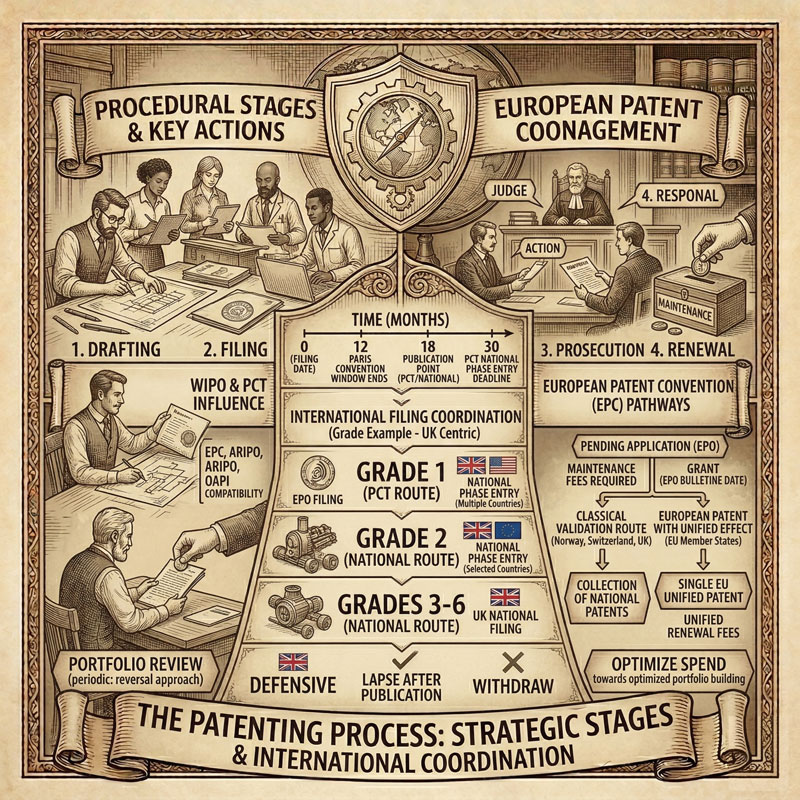
- Drafting
- Preparing the specification which consists of a description, claims, an abstract and drawings.
- Filing
- Placing the specification along with details of the applicant On File to obtain a filing date and an application number.
- PROSECUTION
- Everything that happens between Filing and the patent taking legal effect.
- RENEWAL
- Further fees are required, often annually, to maintain the patent In Force.
Internationally, very similar procedures have been adopted in most countries – which becomes very apparent to practitioners when they stray into other areas of the law. This similarity has been encouraged by membership of WIPO (the World Intellectual Property Organization) and adoption of the Patent Cooperation Treaty. Thus, for example, publication under the PCT can replace national publication at the same eighteen-month point as a national publication. National compatibility is also required for regional systems such as the EPC, ARIPO and OAPI.
Portfolio Review starts with a Policy for building a portfolio. The review process then considers WHAT is to be protected and WHERE. After filing, the relevant questions then become what is to be maintained during prosecution and then what is to be renewed. At periodic review meetings, this is often considered in reverse order, ending with any new inventions to look at.
In most countries, a first application must be placed on file before the invention is disclosed. A twelve-month window under the Paris Convention is then created for filing similar applications elsewhere. The PCT effectively extends this period by a further eighteen months at which point a final selection is required for national phase entry. Further countries or regions cannot be added after national phase entry deadlines have passed.
The prosecution phase includes substantive stages and administrative stages. Missing any of these can result in the loss of the application. Thus, substantive stages involve Examiners raising objections and Applicants submitting arguments and amendments. The Examiner issues an ACTION and the Applicant submits a RESPONSE.
In some countries/regions, Maintenance Fees are required while applications are pending. This includes the European Patent Office. At the EPO, the patent takes legal effect when grant is “mentioned” in the European Patents Bulletin. Thus, the EPC makes reference to this Date of Mention of Grant. Traditionally, the European Patent was then validated in each member state to become a collection of national patents each enforceable in the national courts. This is now known as the “Classical” approach.
For member states of the EPC that are also members of the European Union, a single European Patent with Unified Effect is available. Classical validation is still necessary in Norway, Switzerland and the United Kingdom but in the EU the patent remains unified and enforceable across the EU. Different Renewal Fees are required to renew a Unified European Patent compared to maintenance fees for pending European applications.